
Garage Door Sensor Not Working in League City, TX - (346) 220-4724
Sensor diagnosis for a city built mostly after 2000, with a documented flood history along Clear Creek
- Sensor alignment check on both sides of the track
- Lens cleaning — dust, glare and spiderwebs block the beam
- Wiring and connection point inspection
- Bracket check for rust or corrosion from past water exposure
- Opener logic board and close-force settings
More about this in League City
A garage door sensor not working means the door won't close all the way, or it starts down and reverses back up before it reaches the floor. The opener is reading a bad or blocked signal from the two small sensors near the floor and refusing to finish the cycle rather than risk closing on something. The broader rundown of same day garage door repair League City explains how these jobs get priced.
Call (346) 220-4724 and a crew working the League City area will get the sensors checked and the door closing again.
Garage door sensor not working — start with alignment
Two sensors sit a few inches off the garage floor, one on each side, aimed at each other so they see a straight, unbroken beam. If one gets bumped by a car, a bike or a stored box, the beam goes crooked and the opener won't let the door close no matter how many times the remote gets pressed. This is the single most common reason a garage door sensor not working call turns out to be a five-minute fix once someone's looking at the bracket instead of the opener.
A garage door sensor not working right after rain
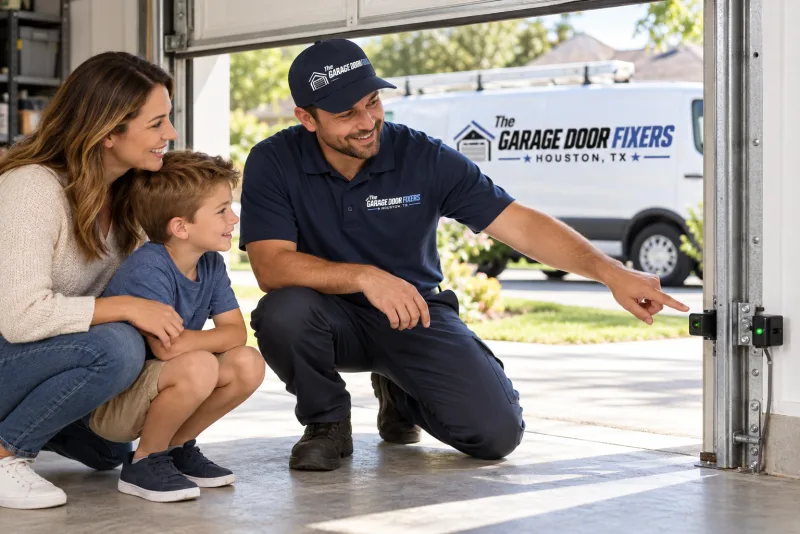
If the sensors only act up when it's wet out, or the light on one of them flickers instead of staying steady, that points to a wiring or bracket problem rather than something blocking the beam. That's worth checking against the sensor housing and connection points directly rather than guessing from inside the house.
Why League City's newer housing still gets a garage door sensor not working
With roughly 55% of League City's homes built after 2000 and a median construction year around 2003, most garage door hardware in the city is newer than what's typical in older Harris County suburbs — but newer doesn't mean immune. A sensor bracket that's now 15 to 25 years old is old enough for the plastic housing to crack or the alignment to drift, and that's a manufacturing-age issue rather than anything to do with the house being old. A related fault, League City garage door roller replacement help, has its own page.
Garage door sensor not working in League City's flooded subdivisions
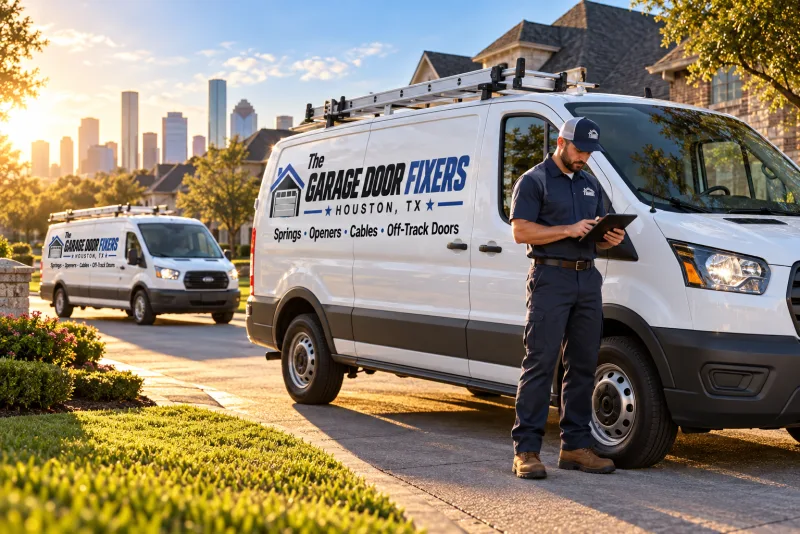
Hurricane Harvey put standing water into an estimated 7,700 homes across League City in August 2017, about 23% of the city's residences, and the Bay Ridge subdivision alone saw over 90% of its homes flood. Oaks of Clear Creek, Brittany Bay, Newport and Hidden Oaks are among the other named subdivisions that took on water. In any of those areas, a sensor that sat a few inches off a flooded garage floor could have corrosion inside the housing or at the wiring connections that only shows up as an intermittent fault years later — a door that closes fine most days and then won't close at all on humid ones.
What a garage door sensor not working call in League City usually comes down to
In the city's newer growth corridors — areas like those served by Clear Springs High School, which opened in 2007, and Clear Falls High School, which opened in 2010 — a garage door sensor not working problem is almost always alignment or a dirty lens. In the older, previously flooded subdivisions along Clear Creek, it's worth ruling out corroded wiring or a damaged bracket before assuming it's a simple fix.
Don't force the door down manually or hold the wall button through the reversal — that just masks the sensor fault instead of fixing it. For a garage door sensor not working anywhere in League City, call (346) 220-4724. The follow-on page covers garage door sensor repair in League City, TX.
League City service area
Also serving
Mont Belvieu · West University Place · Crosby · Manvel · Conroe
More about the area
Background on the League City, Texas area and how it grew.