
Garage Door Opener Damage in Roman Forest, TX - (346) 220-4724
Stripped gears, burnt boards and motors run past what they were built to lift
- Stripped or chewed drive gear replacement
- Circuit board diagnosis after a trip, spark or dead response
- Motor inspection for overheating or burnt windings
- Chain, belt or screw-drive damage from a bound door
- Force and travel-limit reset once the root cause is fixed
More about this in Roman Forest
Garage door opener damage shows up as a motor that runs but won't lift, a gear that grinds instead of turns, or a control board that trips a breaker and won't reset. It's usually the result of the opener fighting a door problem somewhere else — a bad spring, a bound track, a dragging roller — until something inside the opener itself finally gives out. There is a wider write-up on garage door technician Roman Forest that covers the other faults too.
Call (346) 220-4724 and a crew working the roman-forest area will sort out what's actually broken.
What garage door opener damage actually looks like up close
Inside the opener housing, a small plastic or nylon gear does the actual work of turning the drive mechanism, and it's built to handle the load of a properly balanced door — nothing more. When something else is wrong, a stuck roller, a spring that's lost tension, a track that's pinched, the opener doesn't know the difference. It just keeps drawing power and pushing, and that gear is usually the first part to strip its teeth or shatter outright.
A burnt circuit board is a different kind of garage door opener damage

A stripped gear is a mechanical failure. A scorched or dead control board is electrical, and it points to something else entirely — a motor drawing too much current for too long, a wiring short, or in some cases just age catching up with the unit. Once a board goes, the opener won't respond to the wall button or the remote at all, even though the motor itself may still be fine. A different cause with similar signs is fix a garage door off track in Roman Forest.
Why opener damage in Roman Forest often traces back to the door, not the motor
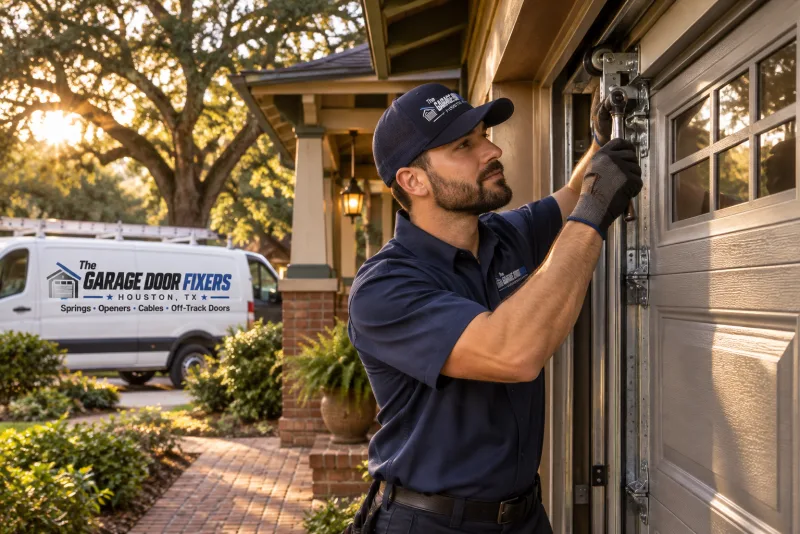
With a median build year of 1996, a real share of Roman Forest's garage doors are still running on original hardware from that era. Springs lose tension over decades, and rollers and hinges wear down long before anyone notices a change in how the door moves. An opener paired with a door that's quietly gotten harder to lift keeps absorbing that extra strain call after call, until the gear or the board finally fails outright — which is why garage door opener damage here so often turns out to have started as a spring or track problem that never got fixed.
What garage door opener damage tends to look like in a city this size
Roman Forest is a small city — 1.5 square miles, 714 housing units as of the 2020 census — and its housing stock isn't spread across many different building eras the way a larger suburb's might be. That means a lot of the openers in town are the same age and were installed under similar conditions, so when one starts showing damage from age or strain, it's a reasonable bet that neighboring houses on original hardware aren't far behind. Roman Forest's owner-occupancy rate, above 92%, also means most of these doors have been run by the same household for years, which tends to push a damaged opener further before anyone calls about it.
Roman Forest sits at 1.5 square miles with no post office of its own inside the city limits, a small footprint that still covers a wide range of hardware ages depending on when a given street was built out. If a garage door opener is grinding, tripping the breaker, or simply not responding anymore, that's garage door opener damage worth having looked at before the motor itself gets added to the repair. For garage door opener damage anywhere in Roman Forest, call (346) 220-4724. A door that does something else entirely may need garage door opener installation Roman Forest repair.
Roman Forest service area
Also serving
Hufsmith · Mission Bend · Spring · Patton Village
More about the area
Background on the Roman Forest, Texas area and how it grew.